
On Surgical Intervention for Small Animal Pyometra and Definitive Advantage
There would be math.

This short essay is a response to Durocher et al’s paper “Immediate surgical intervention for small animal pyometra shows no definitive advantage.”
I would’ve made this a Letter to the Editor at JAVMA, but I’m outside the response window for such a letter. Having doubled children and hospitals in the time since the paper was published online, I’m a bit behind in my journal reading. Still, the study rankled. Instead of bothering Dr. Fortier with this one, I’m sharing with my Substack audience.
This is one of those statistically pedantic little rants to which my wife is occasionally subjected. On the upside, this one is short.1
Drs. Durocher2 et al3 take on a genuinely unsettled question, and their documentation of supportive-care and antimicrobial practice across 137 pyometra cases is a useful contribution. The study’s central claim, the one carried by both its title and its clinical-relevance statement that immediate surgery “may not be superior to delayed surgical intervention”, is not supported by the reported data and, in at least two respects, is contradicted by them.
The stated primary outcome was survival to discharge. One of 137 dogs died, there was an overall mortality of 0.73% (exact 95% CI, 0.02%–4.00%), and the single death fell in the immediate-surgery arm, while the delayed arm recorded none.
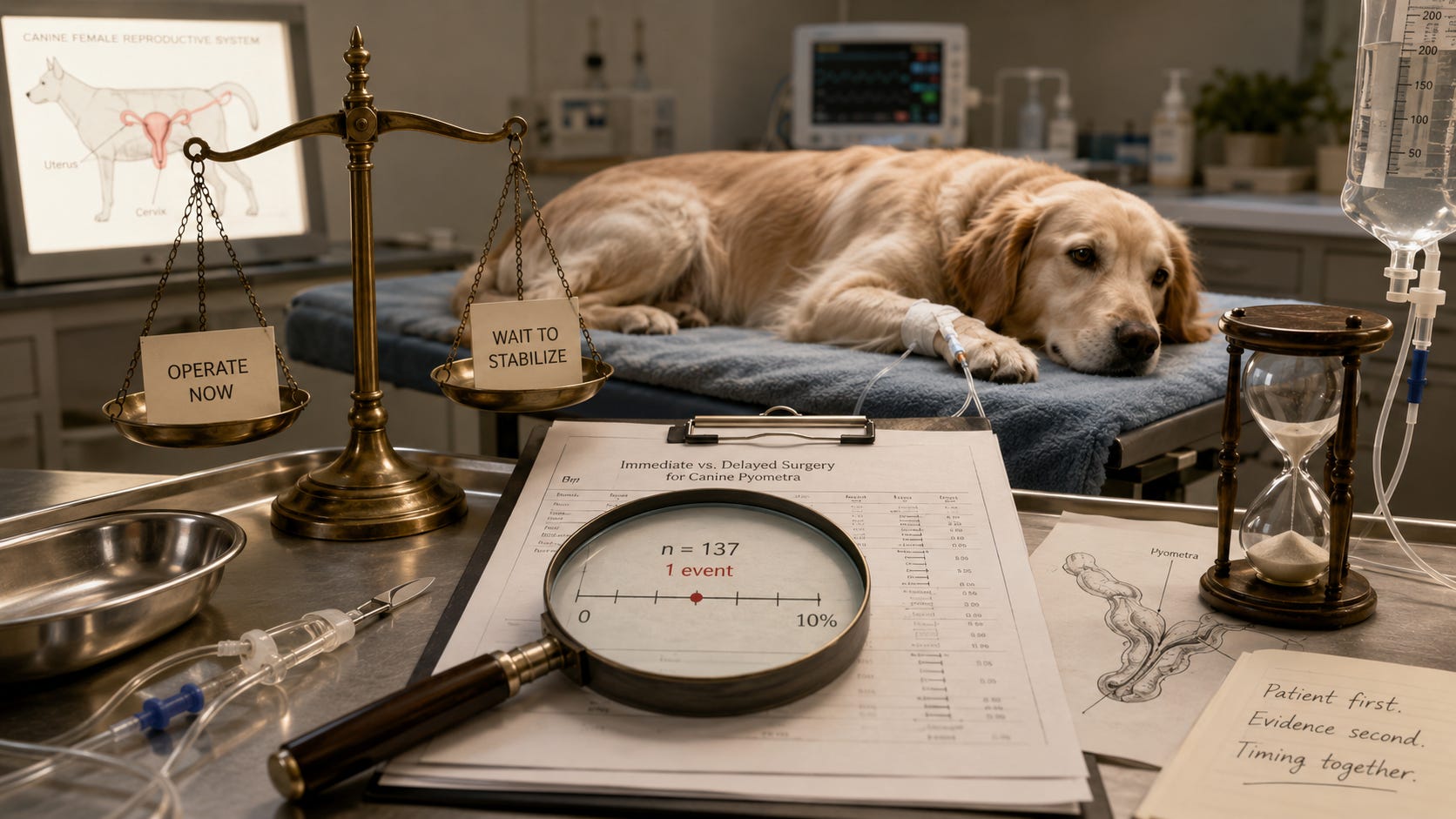
A zero numerator is weak evidence of safety: the rule of three shows that observing no deaths remains compatible with a nonnegligible true event rate.4 No survival comparison between timing groups is reported, and with a single event none would be informative; for an evenly divided sample, the two-sided Fisher exact P is approximately 0.4.
Power for a binary outcome is governed by the number of events, not the sample size. Detecting even a large absolute reduction, for example from 5% to 1%, the upper figure consistent with reported ranges for surgically managed canine pyometra5 would require roughly 570 dogs, more than four times the enrolled sample. And detecting more modest, still-clinically-meaningful differences would require well over a thousand. “No definitive advantage” therefore describes the study’s statistical power, not any property of the treatment. Which is nonsignificant (read: unable to be computed) difference is not evidence of equivalence.6
The interpretation is further compromised by worryingly nonrandom treatment allocation. The authors report that every dog with septic peritonitis, and the sole mortality, underwent immediate surgery. The sickest pyometra patients were eliminated at the outset! The immediate group was thus systemically and systematically sicker (a textbook instance of confounding by indication7)and comparable outcomes despite greater baseline severity, if anything, argue for early source control rather than against it. The direction of any timing effect on survival cannot be inferred from these data.
Finally, the conclusion that immediate surgery “may not be superior” is a noninferiority claim, and establishing noninferiority requires a prespecified margin and adequate power to exclude a clinically meaningful difference8, neither of which is provided by the paper’s observational analysis. The title’s scope is also inaccurate: feline patients were excluded by design, so the findings pertain to dogs alone, not “small animals.”9
Jokes and statistical pedantry aside, there’s value to this paper. And none of what I’ve written diminishes the value of the descriptive work or the importance of the question.
But the data support only a narrower, hypothesis-generating statement: in this cohort no survival difference was detected, in a sample far too small and too confounded to detect one. Presented as evidence that emergent surgery “may not be imperative,” the conclusion risks being read as license to delay intervention in a disease that can still deteriorate rapidly. A prospective, adequately powered, ideally noninferiority-designed canine study is needed before that inference is drawn.
So what’s this all mean?
Less than the title would indicate. The fact is that this study doesn’t move the timing decision in either direction, and that is the point.
It didn’t show that operating immediately helps and it equally didn’t show that waiting is safe. It showed that 137 dogs and a single death can’t tell you much about survival at all. The decision lands back where it always was: with the patient, not the abstract.
And the patient still matters in the old, unglamorous, pathophysiologic ways. There’s a difference between stabilizing and delaying, and the paper muddles the two. Spending a few hours correcting hypovolemia, electrolytes, and acid-base derangements to turn a septic dog into a better anesthetic candidate is good medicine. Reading “no definitive advantage” as license to slot an unstable pyometra into tomorrow’s elective lineup is a dramatically different thing and the study offers absolutely no cover for it.
The distinction bites hardest exactly where the study is quietest: the authors sent every septic-peritonitis case, and their only death, to immediate surgery.
That isn’t evidence that delay is safe; if anything, it’s a faint reminder that source control is what keeps the sickest patients alive. That tells me that their doctors have excellent judgment in deciding which pyometra patients to cut immediately and which ones to sleep on.
The stable, open-cervix dog can probably wait for a proper resuscitation and a daytime table. The closed-cervix dog with a climbing lactate and a flagging blood pressure is the patient the “surgical emergency” framing was built to define and address.
If there’s a portable lesson, it isn’t about uteri. It’s that “no difference” and “no difference we could detect” are very much not the same thing. The space between them is where a the wrong kind of clinical folklore gets conceived. When a paper reports a null, the first question shouldn’t be “what did they find?” but rather “could they have found it if it were there?”
Here, with one event, the answer was no. So measure the creatinine (in mg/dL), stabilize the patient, and make the call about the dog in front of you.
The rant, not my wife. Who, come to think of it, is also short.
Tancredi and Durocher gives me condottiero-versus-House-of-Valois vibes.
Durocher E, Windsor R, Smola C. Immediate surgical intervention for small animal pyometra shows no definitive advantage. J Am Vet Med Assoc. 2026. doi:10.2460/javma.25.12.0854
Hanley JA, Lippman-Hand A. If nothing goes wrong, is everything all right? Interpreting zero numerators. JAMA. 1983;249(13):1743–1745. doi:10.1001/jama.1983.03330370053031
Hagman R. Pyometra in small animals 2.0. Vet Clin North Am Small Anim Pract. 2022;52(3):631–657. doi:10.1016/j.cvsm.2022.01.004
Altman DG, Bland JM. Absence of evidence is not evidence of absence. BMJ. 1995;311(7003):485. doi:10.1136/bmj.311.7003.485
Kyriacou DN, Lewis RJ. Confounding by indication in clinical research. JAMA. 2016;316(17):1818–1819. doi:10.1001/jama.2016.16435
Piaggio G, Elbourne DR, Pocock SJ, Evans SJW, Altman DG; CONSORT Group. Reporting of noninferiority and equivalence randomized trials: extension of the CONSORT 2010 statement. JAMA. 2012;308(24):2594–2604. doi:10.1001/jama.2012.87802
I was also going to point out that creatinine is usually reported in mg/dL rather than the g/dL used in this paper, but it felt kind of mean. Besides, they’re surgeons. I’m glad they bothered to measure a patient’s creatinine.