
Dangerous Veterinarians
On Art, Authenticity, and Advocacy

“Art, by virtue of that free essence I have tried to define, unites whereas tyranny separates. It is not surprising, therefore, that art should be the enemy marked out by every form of oppression." - Albert Camus
In December 1957, Albert Camus stood before an audience at Uppsala University and delivered what would become one of the century’s most powerful statements about the artist's responsibility to society. "To create today is to create dangerously," he declared. "Any publication is an act, and that act exposes one to the passions of an age that forgives nothing."
The same week he would accept the Nobel Prize for Literature, the second youngest person to do so.
You might wonder what a mid-twentieth-century French philosopher's speech at a Swedish university on art has to do with veterinary medicine in America more than 70 years later.
You, my colleagues, are not merely mechanics fixing broken animals. You are practitioners of what is fundamentally a creative art: one that demands the same courage, authenticity, and social responsibility that Camus called for from artists. And in our current moment, that practice becomes political and even polarizing, whether you intended it or not.
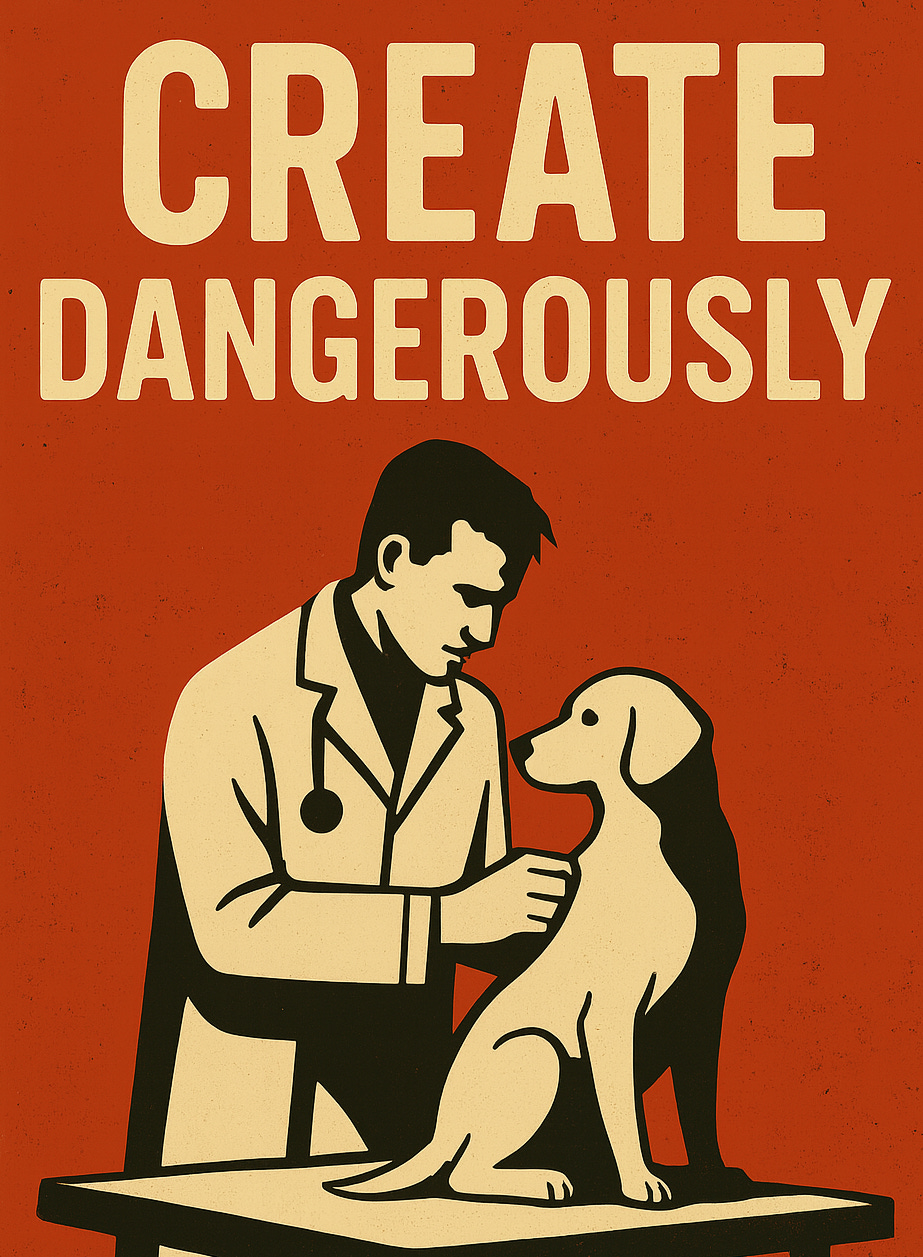
The Veterinarian as Artist
Camus argued that art "cannot be a monologue,” it must speak to universal human experiences while remaining grounded in the reality of its time. Veterinary medicine operates in this same tension. We cannot practice without patients, clients, teammates, and colleagues.. Your work will span the intimate and universal: the grief of loss, the joy of healing, the complex relationships between humans and the animals they love, intensely personal. Yet it unfolds against the backdrop of contemporary pressures like economic inequality, political polarization, technological disruption, and professional consolidation that threaten the values you learned to uphold.
Consider what Camus wrote about the artist's position: "Art advances between two chasms, which are frivolity and propaganda. On the ridge where the great artist moves forward, every step is an adventure, an extreme risk." (It helps if you replace “art” with “medicine” and “artist” with “doctor.”) You practice between the chasms of commercialization and ideology, where genuine care for animals and their families requires constant navigation of forces that would reduce your work to either entertainment or agenda.
The veterinary profession, like art in Camus's time, faces what he called "the passions of an age that forgives nothing." Your clinical decisions will be scrutinized not just for medical accuracy but for their alignment with clients' ethical tenets, religious beliefs, economic circumstances, and social identities. Your existence as an educated professional in an increasingly polarized society marks you as a participant in cultural conflicts you never chose to join.
Speaking Truth in a Wicked World
Camus insisted that artists have a responsibility to speak truth to power, not through adherence to any particular political theory, but through "a commitment to honesty, integrity, and courage in the face of injustice." For veterinarians, this translates into professional courage that goes far beyond technical competence.
Your profession is not politically neutral, despite what you might prefer. When you're one of the few veterinarians serving a rural community, your accessibility becomes a social justice issue. When you treat a transgender client's pet with the same respect you show all your patients, you're making a statement about human dignity, their’s and your own. When you explain why a particular treatment isn't appropriate for a pet, despite the owner's financial desperation, you're navigating complex ethical terrain that extends far beyond the exam room.
As one practicing veterinarian has observed, "veterinary medicine is not a diverse field by the standards of many professions;” about 90% of veterinarians are white, compared to 62% of the American population. This means you carry particular responsibilities for self-awareness and cultural competence. But more than that, it means your profession has the opportunity and, I argue, the obligation to model what authentic inclusion looks like. And not the performative version that Camus would have recognized as propaganda.
The Dangerous Act of Integrity
Camus wrote, "If [art] adapts itself to what the majority of our society wants, art will be a meaningless recreation. If it blindly rejects that society, if the artist makes up his mind to take refuge in his dream, art will express nothing but a negation." This is the painful false choice facing many veterinarians today: become a service provider who tells clients what they want to hear, or retreat into professional isolation that ignores the realities of clients' lives.
The dangerous path, indeed a truly professional one, lies between these extremes. It means providing excellent medical care while acknowledging that"some clients can't afford treatment, others can't even get a ride to the hospital. It means understanding that your technical knowledge must be translated not just across species barriers, but across cultural, economic, and educational divides.
When veterinary students are working 100-hour weeks, when corporate consolidation threatens independent practice, when economic pressures push toward shortcuts and compromises we see that these are not just professional problems. They are symptoms of what Camus called the society that "chose as its religion a moral code of formal principles and that inscribes the words 'liberty' and 'equality' on its prisons as well as on its temples of finance." Though rarely, you’ll note, on its hospitals.
The Courage to Create
Creating dangerously as a veterinarian means refusing both the easy path of corporate conformity and the self-indulgent path of professional isolation. It means building a practice and being a leader, whether in a corporate setting, an independent clinic, or an academic institution, that maintains what Camus called "an equilibrium between reality and man's rejection of that reality."
This requires acknowledging uncomfortable truths about your profession while working to embody its highest ideals. Yes, veterinary medicine struggles with diversity and accessibility. Yes, economic pressures create ethical dilemmas. Yes, the very structure of veterinary education can exploit students and perpetuate systemic problems. Acknowledging these realities isn't performative cynicism or recreational outrage, rather it is the diagnostic prerequisite for meaningful change.
But creation also requires what Camus called "the loftiest work,” that which "maintains an equilibrium between reality and man's rejection of that reality, each forcing the other upward in a ceaseless overflowing." In practical terms, this means becoming the kind of veterinarian who provides excellent care while working to expand access to that care; who maintains professional standards while advocating for humane treatment of students and colleagues; who earns a living while refusing to let financial pressures compromise patient welfare or client dignity.
A Generation's Particular Burden
Today’s students are entering veterinary medicine at a moment when, as Camus noted about artists in his time, "everything is changed and even silence has dangerous implications." The choice to focus solely on your studies while avoiding broader professional and social issues is itself a political choice—one that abandons the field to forces that may not share your values.
The consolidation of veterinary practices, the ongoing mental health crisis in the profession, the accessibility problems that leave many communities underserved are issues that will shape your career whether you engage with them or not. The question is whether you will help shape the solutions.
This doesn't mean every veterinarian must become an activist. But it does mean every veterinarian has a responsibility to practice with what Camus called "clear-sighted earnestness" about the "problems of the human conscience in our times." It means developing the intellectual and moral tools to navigate complex ethical terrain while maintaining your commitment to excellent patient care.
The Freedom in Danger
Camus concluded his lecture with a paradox: "In that risk, however, and only there, lies the freedom of art." The same is true for veterinary practice. The freedom to practice medicine as it should be practiced—with integrity, compassion, and unwavering commitment to patient welfare—exists only when you're willing to accept the risks that come with professional courage.
This might mean standing up to a corporate employer who pressures you to compromise care. It might mean serving clients whose personal beliefs you find objectionable while maintaining your professional responsibilities. It might mean advocating for changes in veterinary education even when it's easier to keep your head down and accept the status quo.
The alternative, what Camus called the "artificial art of a factitious and self-absorbed society,” is veterinary practice reduced to mere technical execution, divorced from moral purpose and social responsibility. It's the kind of practice that might pay the bills but will leave you wondering why you spent eight years of your life preparing for work that feels meaningless.
Create Dangerously
Your clinical skills matter enormously, but they alone are not enough. The world needs veterinarians who can diagnose and treat disease with technical excellence, but it also needs veterinarians who understand their role in the society and the larger human drama; those who recognize that every interaction with a client is an opportunity to model professionalism, compassion, and integrity in a world that desperately needs all three.
This is your call to create dangerously. Not because the risk is fun, but because authentic practice (the kind that honors both your training and your values) is impossible without it. The veterinary profession is shaped by your choices about what kind of practitioners you become. Those choices begin now, in how you approach your studies, interact with classmates and faculty, and think about your future role in society.
Camus wrote that "the artist cannot" judge absolutely, "but rather to understand first of all." Your challenge as veterinarians is to develop this capacity for understanding. Not only of animals and their diseases, certainly, but also of the humans who love them and the complex world in which you'll all live together.
The passions of our age may indeed forgive nothing. But that makes your work more necessary, not less. In a world that increasingly seeks simple answers to complex problems, your profession offers something different: the disciplined application of scientific knowledge in service of life itself.
That's creation well worth the danger.
Beautiful written and so true! I feel like I have become a “reluctant activist” where it can feel like a battle to keep showing up with compassion and integrity, to have the hard conversations, but with kindness and empathy, but its one that's worth fighting.
SO GOOD